Buildings
The Buildings visualization is useful for analyzing the distribution of data by buildings. The visualization takes into account the physical and legal boundaries of buildings.
Overview
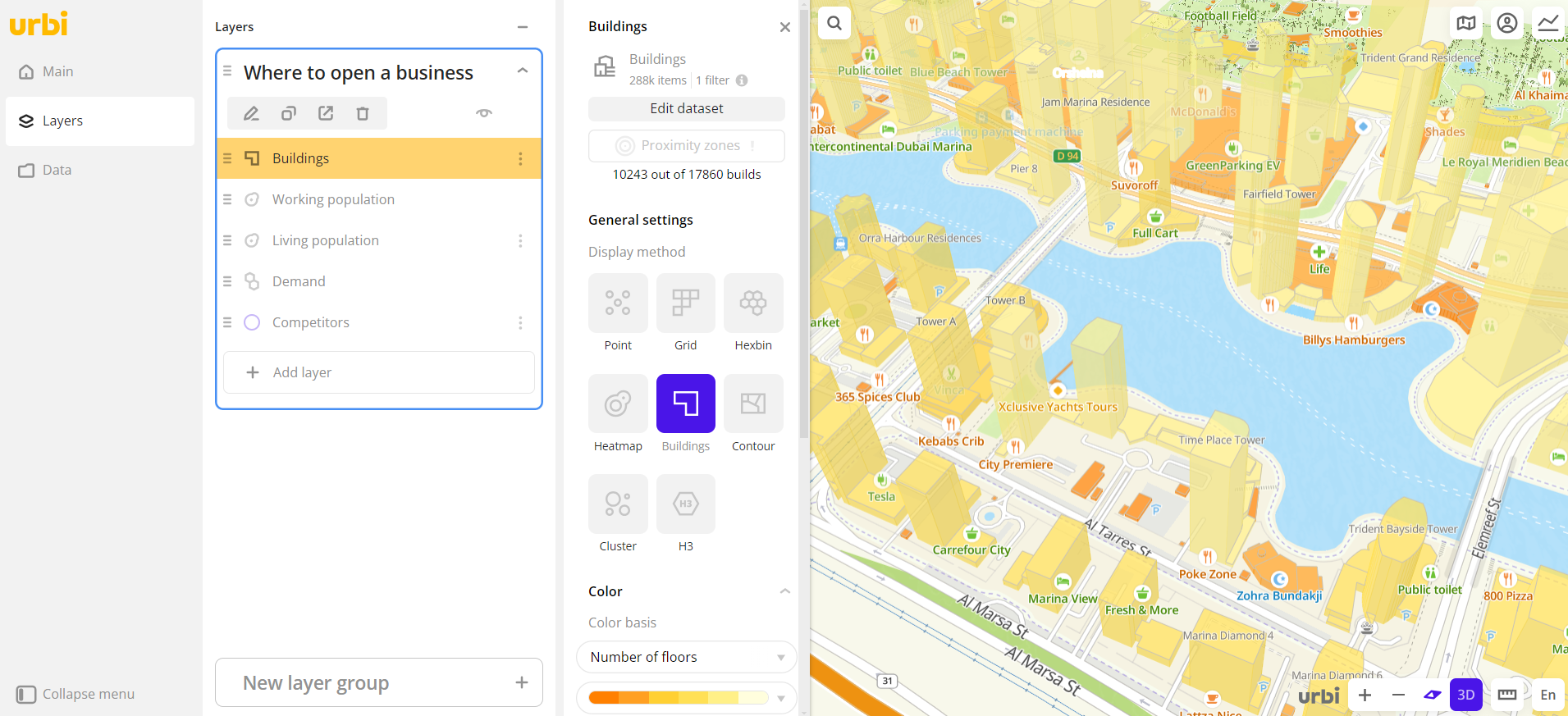
To select a visualization method:
- Go to the Dashboards tab and open the dashboard.
- Open a scene using the arrows
 and
and  . If there is only one scene in the dashboard, it opens automatically.
 - To open the layer, click
 icon and select the required layer.
 - In the General settings block, select the Buildings visualization method.
- Set the remaining visualization parameters if necessary.
The data is visualized on the map as building contours. At lower map zoom levels, the data is shown as centroid points: the centers of the object geometries.
Parameters
Tooltip setup
Parameter | Description |
|---|---|
| Tooltip setup | Enable the option to customize the list of attributes that are displayed in the tooltip when hovering over the building on the map. Select the required attributes and change their order if necessary: for more details, see the Configuring a tooltip section. If the option is disabled, the tooltip shows all attributes from the dataset. |
Color
You can set the color of buildings on the map in one of the following ways:
- Based on a data attribute: the color of each element depends on the attribute values.
- Specify a single color for all elements.
Based on a data attribute:
Parameter | Description |
|---|---|
| Color basis | Numeric attribute that determines the fill color of buildings on the map and in the legend according to the color palette. Available values depend on the data in the sample. To reset the parameter, click  icon next to its name. icon next to its name. |
| Color aggregation type | Function used to aggregate the attribute values located in one visualization element (point or building):
|
| Type of scale | Distribution type used to calculate data ranges in the legend:
|
| Number of ranges | Number of data ranges in the legend and colors in the palette from 1 to 10. Ranges are calculated automatically based on the Type of scale (for Logarithmic, Linear, and Exponential types). To customize ranges manually, enter the required limits or change the order and number of ranges (Adjustable type). In all ranges except the last one, the specified upper (right) limit is not included in the range.To change the order of ranges, hold down  icon next to the range and drag it. To add a range, click icon next to the range and drag it. To add a range, click  icon. To delete a range, click icon. To delete a range, click  icon. icon. |
| Palette | Color palette (a set of prepared color samples). To change the color for a range, click the color in the legend and select a new one from the palette or specify it in the HEX format. To reset the color, hover over it and click icon. The color is also reset when the attribute is changed, but is not reset when the range limits or the number of ranges are changed. Example: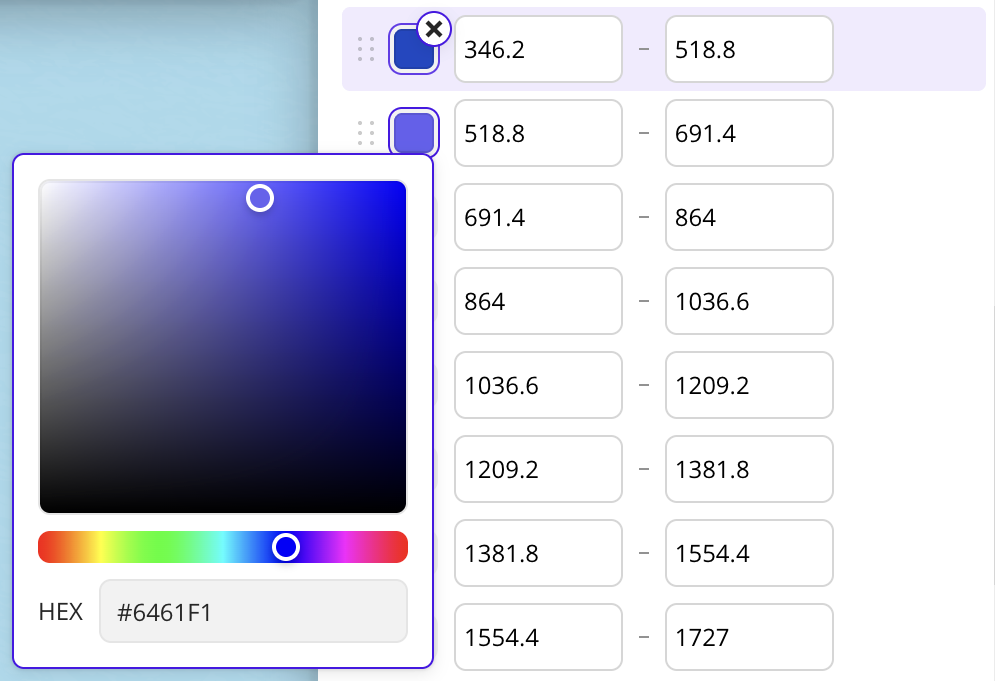 |
| Invert | Enable the option to invert the color palette. All colors in the palette are inverted, except those set manually. |
| Opacity | Opacity of building fill in percent. |
Specifying a single color:
Parameter | Description |
|---|---|
| Color | Fill color of buildings. Reset the Color basis parameter, select a color from the palette or specify it in the HEX format. Buildings on the map will be colored the same. |
| Opacity | Opacity of building fill in percent. |
What's next?
- Getting started.
- Get to know how to work with Data.
- Learn more about Layers, Dashboards, Scenes, and Widgets.
- Get to know more about other Data visualization methods.
- Learn about ready-made Analytics scenarios.