Operations with widgets
Operations below are available for all user widgets. Some operations are available for the Legend system widget: opening in full-screen mode, hiding and showing on the scene, and renaming.
You can work with widgets within a scene. To open the widget dialog:
- Go to the Dashboards tab and open the dashboard.
- Open a scene using the arrows
 and
and  . If there is only one scene in the dashboard, it opens automatically when you open the dashboard.
 - In the top menu of the dashboard, click
 icon.
icon.
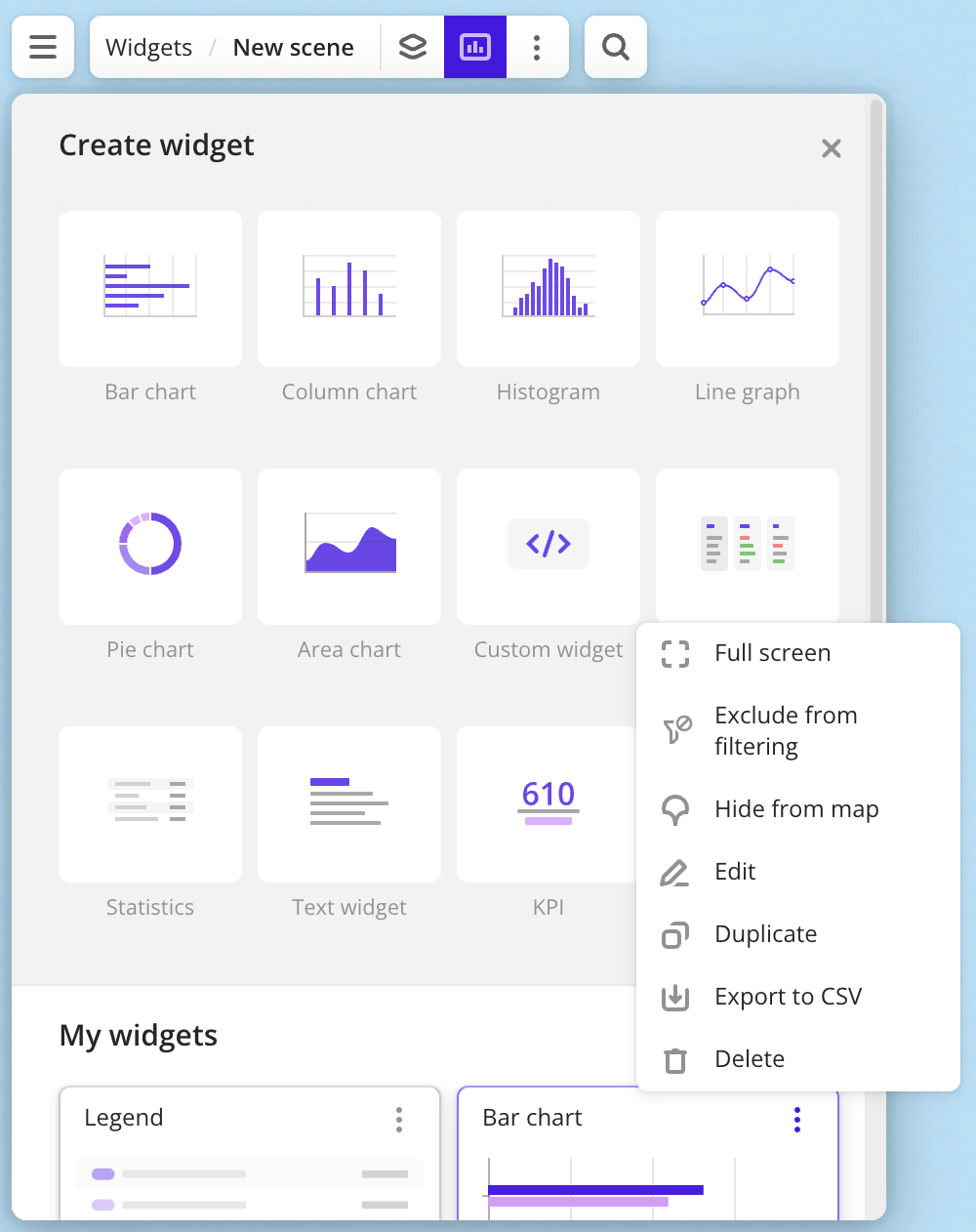
Opening a widget in full-screen mode
Open a widget in full-screen mode in one of the following ways:
- In the list of widgets, click
 icon for the widget and select Full screen.
 - If the widget is shown on the scene, click icon and select Full screen.
Hiding a widget from the scene
Change the visibility of a widget in one of the following ways:
- In the list of widgets, clear the checkbox (
 ) for the widget or click icon and select Hide on map.
 - If the widget is shown on the scene, click icon and select Hide on map.
Showing a widget on the scene
If the widget was previously hidden, you can enable its display on the scene. In the list of widgets, select the checkbox () for the widget or click icon and select Show on map.
Renaming a widget
-
Use one of the following ways:
- In the list of widgets, click icon for the widget and select Edit.
- If the widget is shown on the scene, double-click the widget name.
- In the list of widgets, click
-
Enter a new widget name.
-
Click Save.
Editing a widget
You can edit a widget: select a new data layer and set other widget parameters.
-
Use one of the following ways:
- In the list of widgets, click icon for the widget and select Edit.
- If the widget is shown on the scene, click icon and select Edit.
- In the list of widgets, click
-
Apply necessary changes.
-
Click Save.
In the Legend widget, you can change the order of blocks: for more details, see the Legend instruction.
Duplicating a widget
-
Use one of the following ways:
- In the list of widgets, click icon for the widget and select Duplicate.
- If the widget is shown on the scene, click icon and select Duplicate.
- In the list of widgets, click
-
Specify the widget parameters if necessary.
-
Click Save.
Exporting a widget
You can export a widget to a file (for example, to download analytics results).
The file is created in the CSV format and contains the table with columns depending on the widget type:
-
Bar chart and Column chart (with grouping by one level), Histogram, Line graph, Pie chart, and Area chart: attribute names and their values.
Example:
Attribute Value Villa 2044 Townhouse 1476 Utility structure 333 Commercial building 168 -
Bar chart and Column chart (with grouping by two levels): first grouping attribute, second grouping attribute, and their values.
Example:
Attribute 1 Attribute 2 Value up to 15 1 – 64 3 up to 15 64 – 128 3 16-100 1 – 64 2 16-100 64 – 128 2 16-100 255 – 319 1 101-250 1 – 64 2 101-250 64 – 128 2 -
Comparison: layer names, attribute names, aggregation types, and attribute values in different groups.
Example (here groups are city districts: Presnensky, Begovoy, and Tverskoy):
Layer Attribute Aggregation type Presnensky Begovoy Tverskoy Firms Number of objects Quantity 77 39 25 Firms Rating Average 4.46 4.26 4.38 -
Statistics: layer names, attribute names, aggregation types, and attribute values.
Example:
Layer Attribute Aggregation type Value Firms Firms Quantity 16 Terminals and ATMs 24/7 Quantity 31 Terminals and ATMs Number of reviews Sum 2
To export a widget:
-
Use one of the following ways:
- In the list of widgets, click icon for the widget and select Export to CSV.
- If the widget is shown on the scene, click icon and select Export to CSV.
- In the list of widgets, click
-
Check how the widget will look. Click Export.
Deleting a widget
Delete a widget in one of the following ways:
- In the list of widgets, click icon for the widget and select Delete.
- If the widget is shown on the scene, click icon and select Delete.
What's next?
- Getting started.
- Get to know how to work with Data and Data visualization.
- Learn more about Layers, Dashboards, and Scenes.
- Learn about ready-made Analytics scenarios.